Wednesday, March 12, 2014

23 The real Cobb Salad is like Champagne


23.  The real Cobb Salad was like Champagne


Back in the olden days when I worked in “The Theatre” in Los Angeles, one of my jobs was as Assistant (The Girl) to Theatre Impresario, Jimmy A. Doolittle.  Mr. D. was a larger than life character, and though I have read a description calling him “soft-spoken” I never heard Mr. D. speak softly when he could as well shout. 

“Morning, Girl,” would greet me as I opened the door at 8:30 AM to his wonderful mid-century house perched to overlook Hollywood with another view featuring the Ocean.  “If you’d arrived a little later,” he continued booming, “they’d be closing up shop out there in New York.”  When I suggested that I could arrive at any time, like even 5 AM, he would chuckle and hit the dining room table where he was having coffee with enough force to spill his cup, “do it and we’ll show those lily-livered Theatre producers how it’s really done.”  Of course he did not mean it, and would no more have been ready to get on with it at 5 AM than I would have.  But soft-spoken was not how I would describe the Jimmy A. Doolittle I worked for in those long-ago days. 

We’d commence the mornings with him booming into one or two phones in the dining room while I sat and chatted up various theatres across the USA on one or two other phones in the office down the hall.  We had exciting visitors; producers and agents coming to pitch their newest finds.   Sometimes a person who said he was Jessie Lasky would arrive and perch on my desk to describe one or another of his thousands of humming birds he said he’d brought in by the plane load from the Amazon.   Or Mr. D. would gesture me in on calls to the French to take notes about the next production he’d be bringing in.  

Always around 12:30 PM he’d come striding in, all dapper and ready to “hit the road.”  And he meant it.  We’d stride out into the gorgeous Hollywood day and over to Mr. D’s large Cadillac.  Tossing me the keys with “you drive, Girl,” he’d jump into the passenger seat.  My first time was almost my last.  That car was huge.  And I am not very.  I could not see over the steering wheel and had to look through it to see where we were heading.  If traffic was particularly packed he’d start getting antsy.  “Don’t stop, Girl, for anything.  Just don’t do it.”

“But, Mr. D., there’s a red light.”  Or, “But Mr. D., there’s a person crossing the street.”

“Run the damn fool over, Girl, just run him over.”

“Mr. Doolittle, you know I cannot run over that person.”
 

“Some driver is not going to see you stop, Girl, and will run into the back of us.  Then where would we be?”  He’d chew on that one a while as I continued up and over to The Greek Theatre where we’d start the outing. 
 
File:Greek Theater 2007.JPG
 We’d check on the current productions, and discuss with the box office the returns and then get to the business office to see what was coming in and discuss where the various performers were staying and when they were arriving.  When Mr. D. was satisfied that The Greek was doing its job keeping Los Angeles entertained with the best in Dance and Music during the warm summer nights, we were off hitting the road again.  This time was a little easier, as it was practically down- hill, over to the Huntington Hartford Theatre on Vine Street.  There we checked on rehearsals and into that box office to check receipts and then backstage to chat with the stage hands and the cast if there was a show in rehearsals. 

And now Mr. D. would look at his watch.   Pretty soon I knew that this meant we were about to hit the road once more.  But this time we just crossed it.  We’d cross Vine Street to the Brown Derby restaurant, getting there just as lunch was winding down. 
File:Hollywood Brown Derby 1952.jpg
 
Mr. D. loved this time of day maybe most of all.  He loved that restaurant, and he really enjoyed Mrs. Cobb.  As soon as we’d enter and he’d shout, “Here we are!”  Mrs. Cobb would appear to greet him, her friend, Jimmy.  Soon we’d be seated with her at her special table and the menus arrived.  The first time there for me, Mr. D. grabbed the menu out of my hand. “The Girl does not need a menu,” he announced to Mrs. Cobb.  I wondered if that meant The Girl did not get to eat, just drive the impresario about.  But of course not:  Mr. D. was a most delightful, though loud, and thoughtful person.  He was just showing The Girl all about what one did at the Brown Derby.  So the Girl surrendered the menu which was snatched by the waiter.  And Mrs. Cobb began to hold forth making the order for our lunch.  She said I had to have The Cobb Salad, and Mr. D. beamed. He too was having one he announced.  And Mrs. Cobb told the waiter to make it Cobb Salads all around. 

We talked and perhaps had a glass of wine while we waited.  Mrs. Cobb showed me about and talked about Hollywood history and pointed out some famous producers just ending their lunches.  Of course soon they were over at the table to say hello and good-bye and see your tomorrow.  And our Cobb Salad arrived.

Today Cobb Salads are served in restaurants from Portland, Maine to Honolulu.  They are all made up of chopped and similar ingredients.  But please believe me none of these is a real Cobb Salad.  When the long white platter arrived I was visually stunned.  It looked like an arrangement of gems all set in rows next to each other down the length of the platter.   Each ingredient had been shopped so finely and into such perfect squares that what I really wanted to see were the tiny hands and sharp knives that had made such enchantment.  The tomatoes had been peeled and seeded and cut into the tiniest of rubies; the eggs, yokes and white presented separately for color variation, were again cut into crisp squares. How?  Do not ask me.  But there the individual tiny morsels lay, white and orangey-yellow; the various lettuces also were chopped into tiny bits which  crispy were defined from each other while all being together.  It was an amazing production, and one which made Mr. D. beam.  The head waiter arrived with a large bowl into which he mixed the ingredients he had at hand for the special creamy vinaigrette.  As he did he had a sort of running incantation praying the ingredients into perfection.  “The Coleman Mustard,” he tossed into the bowl golden dust, “juice of a real California lemon,” he squeezed, “olive oil all the way from Italy, like me,” he poured and swirled, “salt from the sea.”  Into this perfection he would crumble some Roquefort cheese which was also in tiny dice on the platter.  This ingredient, he told me, made the sauce perfect once he got it to the right consistency.  This he did vigorously as he talked.  And voila! The sauce was done.  Mrs. Cobb put in a delicate finger and licked.  “Yes, perfect,” she approved.  And so the ingredients were added from the platter. “Each must go in at the right moment for that perfect salad,” she explained, “the egg-yokes last.”  And the golden  pieces were added to the whole wonder, with the crumbled Roquefort just on top, “like snow”, the waiter began to serve.    I know there were small dices of purple black olives “from Santa Barbara up the coast,”  though I do not see them anymore in the list of ingredients.  And, “avocado from Mrs. Cobb’s garden”.

Mr. D was ready; his napkin on his chest.  Large spoonsful of this lovely salad were put into our plates. “Let the lunch begin,” Mr. Doolittle sounded a little chastened in the presence of true gastronomic delight. 


On the way home, “back to work”, Mr. Doolittle was quiet, thinking about I guess that wonderful salad Mrs. Cobb had invented late one night for a hungry husband, made up, she said, of things they used all day in the restaurant.  She herself had chopped that first salad and her husband said it was perfection.  At first, she remembered, it was not on the menu.  But her husband liked it so much that he had one almost every day.  His guests would see this vision arrive, but they could not find on the menu.  So the rest is part of gastronomic – and Hollywood – history. 

As is Jimmy A. Doolittle, the great and booming and charming Theatre impresario.

Strangely I could not find one photo of Mr. Doolittle to add to this blog, though his office was filled with them of him with his many stars and discoveries.  Nor one of Mrs. Cobb, though her restaurants will also filled with those of her and her husband and their famous clients and guests.  I could find some of the Huntington Hartford Theatre, renamed The Jimmy Doolittle not many years before Mr. D’s death in 1997.  And naturally, some of the famous Hollywood Brown Derby.  I did search too for photos of a real Cobb Salad but that has gone the way of the DoDo bird, never more to be seen.

I call the real Cobb salad like Champagne.  All the ingredients were so perfectly prepared, “composed” as the French would say, and so delicately joined together that the taste of the whole was seamless, not one ingredient standing out from the other, the whole a deliciousness;  as is a great Champagne. The Pinot Noir does not stand apart from the Chardonnay, nor the Pinot Meunier from the rest of the trio:  a perfect blend of flavors.  While in Champagne the gas of life, CO2 streams into the consumer’s system elevating one’s mood to ethereal, in a real Cobb Salad the delights of such scrumptiousness elevate the mood too, as I can remember in a more tranquil Jimmy Doolittle after his Cobb Salad “fix”.    So I do proclaim the real Cobb Salad to be like Champagne.  And Jimmy Doolittle too, a character so bubbly he truly can be called Champagne-like.

Tuesday, February 25, 2014

22 Gary Plumley and the Kevans are the Champagne of Aspen's Food and Wine Classic

22  Gary Plumley and Ruth and Bob Kevan are the Champagne of Aspen's Food and Wine Classic

Long before I served Champagne at my first Aspen Classic there was a Classic.
As Aspen's Gary Plumley, co-founder with Ruth and Bob Kevan of Snowmass, tells it, "We were looking for a 'shoulder season', one to shoulder Aspen's business from the skiing season to the skiing season."  He met with mayor of Snowmass and social activist, Bob Kevan and his enterprising wife, Ruth, in their home in Snowmass.  The first Classics were about to be born:  two classics; one in Aspen and one in Snowmass.   Both were aided by the two Chambers of Commerce and the first years grew into such a success that soon the founders were in debt and in need of help keeping up with the growth.  Gary and Ruth and Bob had hoped, as a non-profit, to give the proceeds to the Deaf Camp for children and the Aspen Music festival.  Instead the two Chambers of Commerce had to  bail them out and purchase the festival.  Then the Chambers found a partner in American Express Publishing, which publishes"Food and Wine" magazine, and the rest falls into thirty years of historic success of American gastronomy, and Gary's 'shoulder season' in Aspen was taking off like a rocket.  Or shall I say it:  like a Champagne cork?  POW!

The first years I participated, first with Veuve Clicquot Champagne and then John Scharffenberger's Mendocino Sparkling wines, witnessed such rapid growth that Gary Plumley's Of Grapes and Grain wine shop's back room was burgeoning with cases sent by distributors.   Next Of Grapes and Grain's parking lot had to be fenced off with a night patrol keeping all the cases safe for the Food and Wine Classic tastings in the tents in the center of town.  It was great fun like a hockey scrimmage all the coming and going and popping of corks and shouting to friends not seen since the last year's Classic.  Yes indeed a real Classic was growing.  And Food and Wine was partnering with style with the Aspen community.

When Julia Child gave her support and entered the scene, the Young Chefs of America competition was born with Julia as the Queen of those kitchens.  The Young Chefs were all thrilled meeting Julia. I have those annual receptions pictures in my mind:  Julia surrounded like the rose she was by all those white toques and jackets of the Young Chefs.

The photos below are from my annual picnic given for Julia at the Jerome Hotel at the end of the Food and Wine Classic.  I will describe the participants in the photos and the picnic in detail in my next book, "Julia's Last Letter."

So I name Gary Plumley a true Champagne person, and the Aspen Food and Wine Classic he spearheaded into existence for Aspen's 'shoulder season' a veritable profusion of Champagne's gas of life CO2, stimulating and giving life to Gastronomy and to Aspen and to all who visit and participate in this elegant and wonderful event.

Meanwhile Julius Caesar is asking for his own blog, and so I will begin Julius's blog tomorrow.
For today, Nunc bibendum est, and sign up to go to Aspen's shoulder season - The Food and Wine Classic.

Madeleine, Madam Champagne
www.madeleinedeJean.com

Monday, February 24, 2014

21 Tina Packer and Shakespeare are like Champagne

21 Tina Packer and Shakespeare and Company are definitely like Champagne

San Miguel Writers' Conference
At San Miguel de Allende Writers' conference I met up with Tina Packer, a some-time-ago classmate from London's Royal Academy of Dramatic Art, and her Shakespeare and Company production of "Women of Will", breathtakingly performed by Tina and Nigel Gore to a standing-room audience.  

Before, sitting in her acting workshop, I learned so much about William Shakespeare, whose advent upon the great stage in London was, some say, heralded by the comet of 1590.   Tina spoke of the Elizabethan age ending that of closed, Church-bound Mediaeval Europe, and opening the age of the Individual.  For the fist time individuals were allowed books; printers and presses flourished;  and especially attendance at London's fourteen Theatres.  In 1589 reading in silence was something unknown.  Gloriana herself had a "Reading Room" to which she retired in private to read aloud to herself her important documents of State, understanding what they contained by hearing the words:  it was an age where reading still meant "sounding out loud."   

Surely those lucky theatre audience members who sat and listened, and perhaps spoke aloud with the actors in the great theatre, were made more alive by words soaringly painting love, war, hate, envy, lust, mercy, mountains turned into clouds,  within that little "O", the great Globe, the words sounded out loud of William Shakespeare; lucky attendees made more alive, like Champagne.
File:Hollar Long View detail.png
The work that Tina and Nigel do to enlighten, like comets, the lives of those of us who hear the words of the Bard, acts like Champagne on our souls and illuminates our minds like "...some meteor that the sun exhales, to be to thee this night a torch-bearer, And light thee on thy way...".
(words first spoken by the boy-actor playing Juliet in 1591, so it is likely William himself had arrived in London some years earlier like 1588 or '89, and by the time the Comet of 1590 flared over London it was underlining the knowledge that a great poet was illuminating the lives of Londoners and soon would all of the world.) 
If you are lucky to catch a performance of Women of Will, or any other of Shakespeare and Co.  in Lenox, Massachusetts or anywhere in the world (like in Prague this late Spring), don't walk, run to get tickets.  And buy a bottle of Champagne to celebrate with afterwards their performances that bring illumination.


Before you go please read Shakespeare and Company's Mission Statement and find the answers to these important questions:
What does it mean to be alive?
How should I act?
and
What must I do?
Shakespeare and Co believes that the creative impulse is essential to the human soul and the arts are the realized expression, creating in the creator and observer alike compassion and humanity.  Read more at the site please.
Go to see how what Tina and Shakespeare and Company are doing to create life and understanding, buoyed on the gas of life, like Champagne.
Sante!  and praise for the work of Tina Packer and her work in theatre art.
Madeleine
Madam Champagne
Post Script:  in 1969 I took my little daughter to see the great French actor, Louis Seigner perform le Malade Imaginaire at the Comedie Francaise.  That afternoon was Maitre Seigner's 180th performance, an iconic role for him.  The audience spoke the lines, at first softly, and finally sounding, some shouting, the words with the great actor.  Such a tribute: they had memorized the whole play.
My daughter was transfixed during listening to and somewhat participating in so  dramatic an afternoon.
www.madeleinedeJean.com 

Wednesday, February 12, 2014

20 Steven Spurrier's Third Judgment of Paris


20.  Steven Spurrier’s Third Judgment of Paris


We all know that Steven Spurrier, MW, founder of wine emporium Caves de la Madeleine in Paris, off Place de la Madeleine, showed his business-savvy and wine-knowledge confidence when he introduced taste-before-you-buy in that Paris wine shop in the 1970s.  

Steven and I first met at the Heublein wine auctions, and later in his wonderful Caves which diversified into a bistro as well.  Our mutual friend Georges Lepre also took me there when he was Chef Sommelier at the Hotel Ritz just up from Madeleine in Place Vendome.

Steven’s wine shop-bistro became a natural meeting place for wine lovers.  And among them in those early 1970 years was the real Charles F. Shaw.  Chuck at that time was working in the banking profession in Paris.  He frequented Caves de la Madeleine, and became inspired to visit Georges Duboeuf in Beaujolais.  The rest is history.  Chuck returned to the USA from banking with some vine cuttings in his socks of Duboeuf’s Gamay Noir au Jus Blanc and planted them in rolling vineyard acreage outside of St. Helena and created the fine Charles Shaw Winery.   
 
(Chuck Shaw today at his new winery in Michigan.)

By the mid 1970s Steven Spurrier had travelled to the USA and its vineyards in the west, and knew that there were splendid wines being produced.   Knowing the French intransigence when it came to the superiority of their wines, he created a blind wine competition with the wine-makers as judges in which there were representatives from the same grape varieties from both USA and French wineries.  When the blindfolds were removed he startling results are considered the “Judgment of Paris” because they turned the wine world on its ears:  many Napa wines toppled the French varieties, causing quite a stir and thankfully not a war.

The phrase “Judgment of Paris” takes us back all the way in Greek Bronze Age history and mythology to the son of King Priam of Troy who was called Paris.  And because he was so beautiful in more modern times the great city of Light on the Seine took his name.  But way back around 1250 BC three Greek goddesses knew that each herself was the most beautiful goddess in the world.  And a beauty pageant was held.  The contestants were goddess Athena, goddess Hera, and goddess Aphrodite.    Things were going just fine in the competitions, singing, dancing, story telling, just like at Miss America’s events today.  But the goddess of discord, Eris, had to arrive and stir things up.  She challenged Paris to say right out who was the fairest of them all.  Poor Paris. He hemmed and hawed.  But Discord was bristling for a judgment.  And Paris gave his judgment; the winner was Aphrodite. 

This was therefore the First Judgment of Paris.  And it caused a war.  The Trojan War.

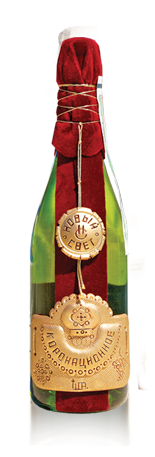
The 1900 Paris Exposition’s wine competition in which Prince Golitsyn’s sparkling Novy Svet from the Crimea topped Champagnes from Champagne and won the honor of putting the word Champagne on the bottle can rightly therefore be called the Second Judgment of Paris.  It did not lead to anything but more understanding and broadening of friendships.

And the cleverly-named wine-competition Steven Spurrier organized is rightly the Third Judgment of Paris.

These competitions keep wines and wine-makers striving for the very best. 

And while beauty pageants often are hard contested thankfully since 1250 B.C. no more wars have been caused over the results.    So far.


Sunday, February 9, 2014

19 Prince Golitsyn's Champagne

19.. Prince Golitsyn's Champagne:
Novy Svet Winery's "Coronation" Sparkling Wine


In 1900 at Paris’s World Exhibition, an unusual bottle was included in the Champagne-tasting competition.  Russian Prince Lev Golitsyn entered his Novy Svet, method champenoise, full-mousse wine into the prestigious competition for Champagnes.
The envelope please:
Prince Golitsyn’s Crimean sparkling wine, in a blind-tasting, - the Premier Judgment of Paris – came in first: overturning; mind-blowing; upsetting all the esteemed judges’ taste-buds.  And thus today, the only vineyard in the world outside of the DOAC of Champagne, France, whose wines can legally be called Champagne is in the Ukraine, Crimean Novy Svet. 
The Prince was a not only a member of the Russian Royal Family, but an experienced oenologist who understood that his Crimean land was on the golden parallel, between which the finest of wines can be produced.  In 1896 his sparkling wines were served at the festivities for the coronation of the newest Tzar.  It was from one of these wines produced for that evening that came the bottles entered at the Paris exhibition of 1900.
As a result of this startling Judgment the Prince’s sparkling wines were deemed worthy of bearing the word Champagne, making them today the only sparkling wines in the world outside of Champagne to be so blessed.  Quiet an official honor the Exhibition’s Judges bestowed.
The winery has been restored, as well as the underground caves.  Visitors to the Crimea should seek out and visit this world-class Champagne producing winery.
Let the Games begin!
Caesar would be proud of how his invention has spread.
 
The Night Julius Caesar Invented Champagne


Friday, January 31, 2014

18 Julius Caesar Veneris Happy Julius Caesar Friday


18.  JULIUS CAESAR VENERIS:  Happy Julius Caesar Friday!


From: Military Tribune, Gaius Volusenus
                To:  The Empire

TIDINGS, citizens.  Ave Socii.
                Today Imperial General CAIUS JULIUS CAESAR rides again. 

His history, as told in
                The Night Julius Caesar Invented Champagne
                is now published and available to all within the Empire, and those without too,
                through Amazon.com.

SIGNED: Gaius Volusenus, IV, Commander of Caesar’s cavalry.
Ave, et vale.
 

Below a synopsis of The Night Julius Caesar Invented Champagne:
 
Rebecca, modern-day wine-expert and ‘nose’, never dreamed she’d become a wine-detective too. But when Doctor ‘47 and his dark forces continue saturating the market with chemically made copy-wines, ready to decimate anyone in their way, especially Rebecca, she travels across time and space—escorted by Julius Caesar, Wolfgang Puck and Julia Child—to find the first vine. Will Rebecca prevail and save wine for Pharaoh Narmer to sign peace treaties with it in 3000 B.C.; for King Nestor to inherit wine and with it postpone the Trojan War in 1250 B.C.? Indeed will Rebecca with Caesar invent Champagne in 50 B.C. and foil Doctor ‘47?
 
The Night Julius Caesar Invented Champagne takes you on a dramatic adventure over eleven thousand years to the birth of Dionysos.
 
Praise for Madeleine de Jean’s The Night Julius Caesar Invented Champagne
“Through the lens of a Champagne flute Madeleine broadens the scope of our culture’s history and the roots of our taste for great wines.” John Scharffenberger, Scharffenberger Sparkling and
Scharffen Berger Chocolates.
 
When Madeleine de Jean opened the first wine bar in the US in New Orleans with Chef Paul Prudhomme and became the first woman sommelier in the world, she was expanding her dramatic talents from stage and screen which had been honed at The Royal Academy of Dramatic Art and Paris’s Comedie Francaise Conservatoire. Her detecting and tasting in archives and vineyards for decades results in The Night Julius Caesar Invented Champagne, in which ‘Madam Champagne’ continues sharing her beliefs in the civilizing effects of wine and Champagne. http://champagnetoujours.blogspot.com
____________________________________________________________________________________
Nunc bibendum est.
Please find more on Madeleine de Jean's Author's page
The Night Julius Caesar Invented Champagne
now released on:  Amazon.com
 
Hail Caesar!


____________________________________________________________________________________________________


Tuesday, January 28, 2014

17 ROSE WEDNESDAY: CHAMPAGNE GOSSET GRAND ROSE


17 ROSE WEDNESDAY:  CHAMPAGNE GOSSET GRAND ROSE.

Gosset has been making red wines in Champagne, in Ay, since before Champagne’s bubbles were gotten under control.  In 1584 Pierre Gosset made slightly sparkling red wines from his Pinot Noir vineyards in Ay.  Ay is unusual in that, situated between the Montagne de Reims and the Cote des Blancs, it is a vineyard commune in Champagne where both Grand Cru Pinot and Chardonnay vines are grown.   

Today the Gosset family’s original properties remain intact and have grown.  Owned now by the Cointreau family, Champagne Gosset takes pride of place as the oldest family-owned Champagne house in continual existence.

As from the start Gosset’s vines in Ay produce on their chalky soil Champagnes of delicate but pronounced minerality which melds into the floral, almost rose flavored Pinot juice to produce Rose Champagnes of complexity and brilliant color which is brightened by the chalky soil.  The Grand Rose Brut Champagne is one which should be sought in the market.  While the Cointreau family has increased the vineyard holdings of Champagne Gossset and do plant the three currently acceptable vines, Chardonnay, Pinot Meunier and Pinot Noir, this Rose is composed of 55% Chardonnay and 45% Pinot Noir.  Of the Pinot some 11% is from Pinot grapes vinified on the skins to offer the final assemblage a brilliant pink-orange color.   Because Gosset remains one of the few Champagne houses that does not allow malolactic fermentation in order to enhance less fruity characteristics and underline their Champagnes’ formal style.  The resulting Grand Rose is a truly regal Rose Champagne, one certainly the flamboyant Sun-King, Bourbon Louis XIV enjoyed.  Let your eyes enjoy it first as the color is sun-like and with the small persistent bubbles is joy in a glass.  Be kingly-daring and use a wide old-fashioned coupe to perceive its color and tiny bubbles.  The aromas of roses and oranges is one to dream of when the bottle is finished.


Did you know Julius Caesar’s vineyardists brought from the Allobrogians many vines they planted it in Champagne, among them an almost mythical one soon they called Rose Champagne?  Read about this in my novel, The Nght Julius Caesar Invented Champagne.   www.madeleinedeJean.com; Amazon.com.